
Fantasy Football Predictions For The 2026 Rookies: How The Cupps Model Projects Their Ceilings
Alex Cupps breaks down how his CUPPS model views the ceiling of each of the 2026 rookies in fantasy football.
Welcome back to another Friday edition of Cupps’ Cupboard, everybody! This week, I’m writing what I think will be my most important article of the offseason: the overview of my machine learning model’s predictions for the 2026 rookie class.
Before we jump into the predictions themselves … I’m guessing many of you hear the words “machine learning” thrown around all the time, but have never really understood what it means. And that is totally fine! I’ll put on my professor cap for a quick lesson.
How The CUPPS Model Predicts Ceilings Of The 2026 Rookies In Fantasy Football
Let me frame it this way: imagine you have a dataset of 1,000 houses that have sold in the past few years. For each house, you know a bunch of things about it:
- Square footage
- Number of bedrooms/bathrooms
- Zip code
- Age of the house
And for each house, you also know the answer—how much it sold for.
So you create a model that will help you predict the sale price of a house before it sells. The goal is to create a model that "learns" from the 1,000 past sales, recognizing patterns in the data. For example, bigger houses tend to sell for more, certain zip codes are more expensive on average, older houses sell for less and so on.
The model picks up on these patterns and uses them to estimate a price.
To test how good the model actually is, you take a chunk of houses (say 300 or so) and hide their sale prices. Using only what it learned from the other 700 houses (features AND prices included), the model looks at the features of those 300 houses and makes its best guess at what each one sold for. Since you actually know the real sale prices, you can then check the model's guesses against reality and see how close it got. The closer the guesses, the ‘better’ the model is!
Now substitute houses for college football players. Instead of square footage, bed/bath counts and zip code, we’re dealing with production metrics, physical archetype/athleticism data and draft capital.
Instead of evaluating the specs on 1,000 houses, we’re evaluating the college data on roughly 1,000 historical running backs, wide receivers and tight ends that have played in the NFL since 2014—and instead of predicting how much a house would sell for, we’re predicting a player’s fantasy ceiling in the NFL.
When creating a model like this, it’s super important to understand what you want to predict. What are you going to define as the “answer” the model should be trying to solve for? In the case of creating a model for fantasy football, there are several that come to mind:
- Average FPPG across first three seasons: This could be a good one if you’re looking to gauge what’s most important when predicting the guys that come into the NFL and immediately produce.
- Average FPPG across career: Maybe you just want to predict the overall success across players’ entire careers. Valid, but could introduce some noise (i.e., players that linger in the league doing nothing for several seasons, dragging down/diminishing how impactful they were in their primes).
- Average FPPG across most impactful seasons: This is what I chose for my model. I wanted to truly gauge the impact of these players at their absolute peaks. I defined my “answer” as the average FPPG across the three best seasons of each player’s career. Keep in mind that any predicted values you see from here on out are trying to predict this.
One thing that makes creating a predictive model for fantasy football so difficult is that the sample of truly impactful players is so small.
Think about it—the model could be really good at predicting fantasy success on average, but how much do we really care about it nailing the players that score 4.3 PPG across their three best seasons? Sure, it will make the R^2 of the model seem better on the surface, but it’s going to lead to a systemic issue of underestimating every single player (even the best prospects in history) because it’ll dismiss any of the true league-breakers as outliers.
To address this, I do something called sample weighting—this essentially means that when we train the model, we make certain players count for MUCH more when it comes to prediction. For instance, if the model is learning from a player like Ja’Marr Chase, it would see something like this:
Prolific overall prospect (100th percentile in CUPPS Score among WRs)
- Elite production metrics
- Elite size/athleticism
- Early draft capital
→ 21.16 FPPG across best 3 seasons
The model would prioritize this player’s profile 10x more when it comes to decision-making. This allows us to directly focus on solving the puzzle of what matters most when predicting elite ceilings in fantasy football.
If you want to look back at my model’s predictions for the 2025 rookie class at each position, you can find the thread over on X. These are still very relevant … and one of the biggest reasons I’m so bullish on Ashton Jeanty going into his second season!
Now, without further ado … let’s take a look at my ceiling predictions for the 2026 rookie class:
Running Backs
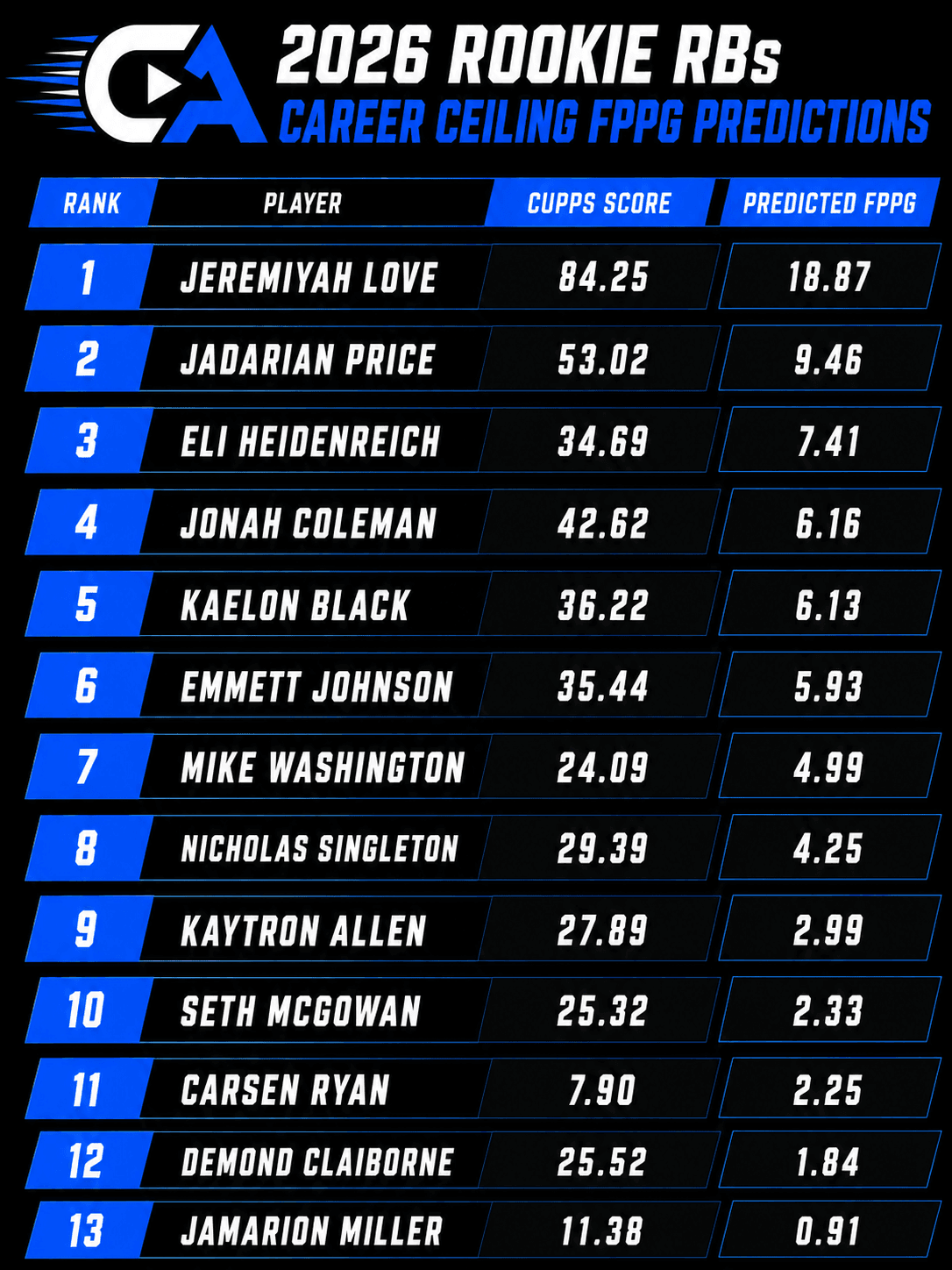
Key Takeaways:
- Jeremiyah Love is as advertised. A predicted ceiling of around 19 FPPG across his best three years puts him in rare company among some of the league’s best backs.
- There is a massive tier break between Love and any other RBs in this class, talent-wise. Jadarian Price, the consensus RB2, comes in at 9.46 FPPG, putting him in a very replaceable range.
- Eli Heidenreich comes out as the third-highest projected ceiling RB after being drafted 230th overall (!!!). This is insane to see from such a late-round draft pick, but it makes sense when you start digging into how absurd his receiving profile is.
Wide Receivers
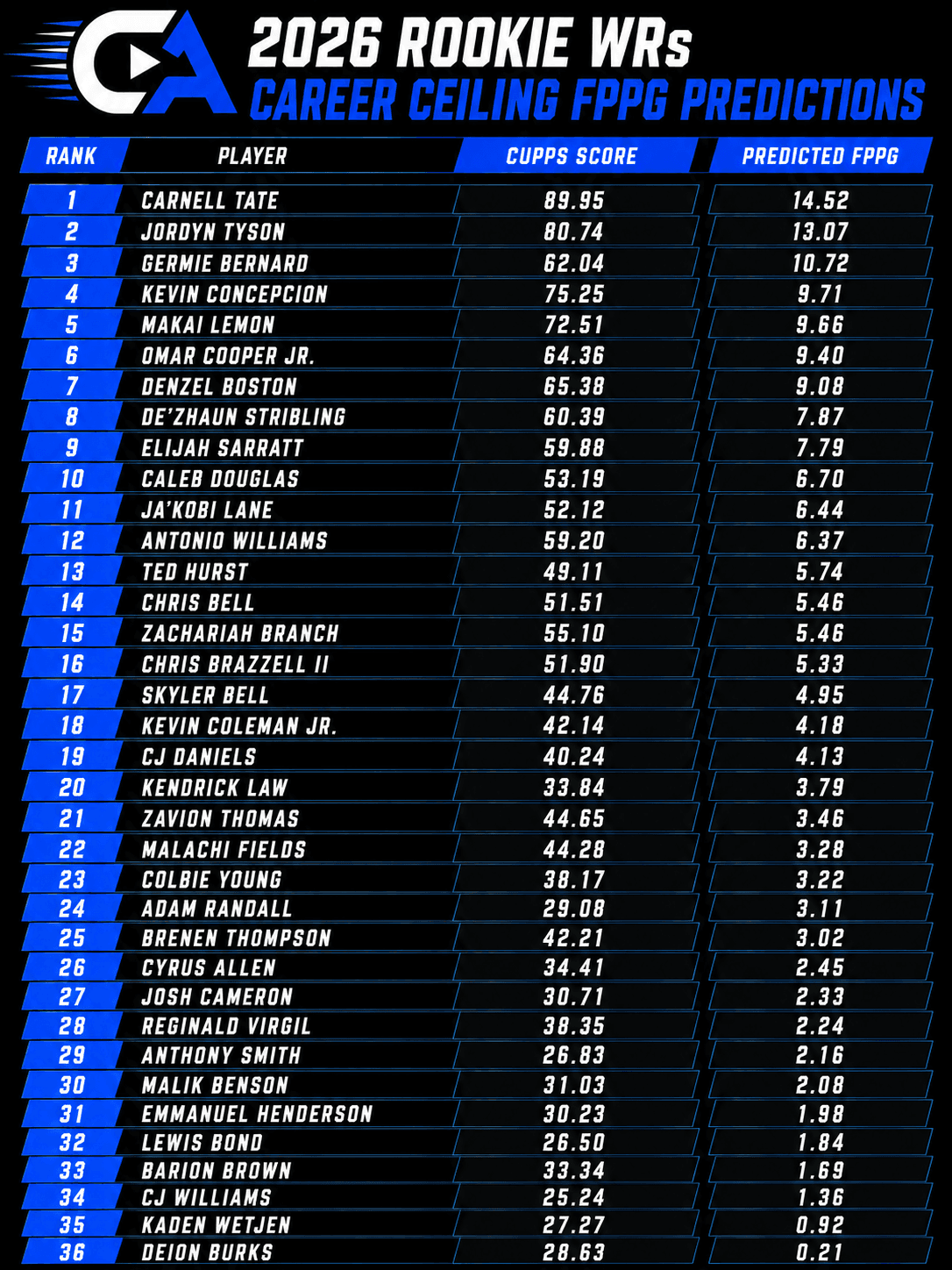
Key Takeaways:
- Carnell Tate comes out as the clear WR1, projecting around 1.5 FPPG higher than Jordyn Tyson over their best three seasons. This stems from the model putting a lot of weight into program strength metrics, where Tate’s collegiate program (Ohio State) was in a different stratosphere than Tyson’s (CU Boulder and Arizona State).
- Germie Bernard comes out as the WR3, and the only other WR projecting for 10+ FPPG. This one came as quite a bit of a surprise to me, since Bernard scores worse in nearly every area than Concepcion and Lemon. He still comes out much lower in CUPPS Score than those two, but an interesting data point nonetheless.
- Elijah Sarratt’s elite production profile pushes him above multiple WRs drafted in the rounds ahead of his—including his fellow rookie Raven, Ja’Kobi Lane.
- Caleb Douglas comes out ahead of his fellow rookie Dolphin, Chris Bell—although neither of them particularly pop in the numbers.
Tight Ends
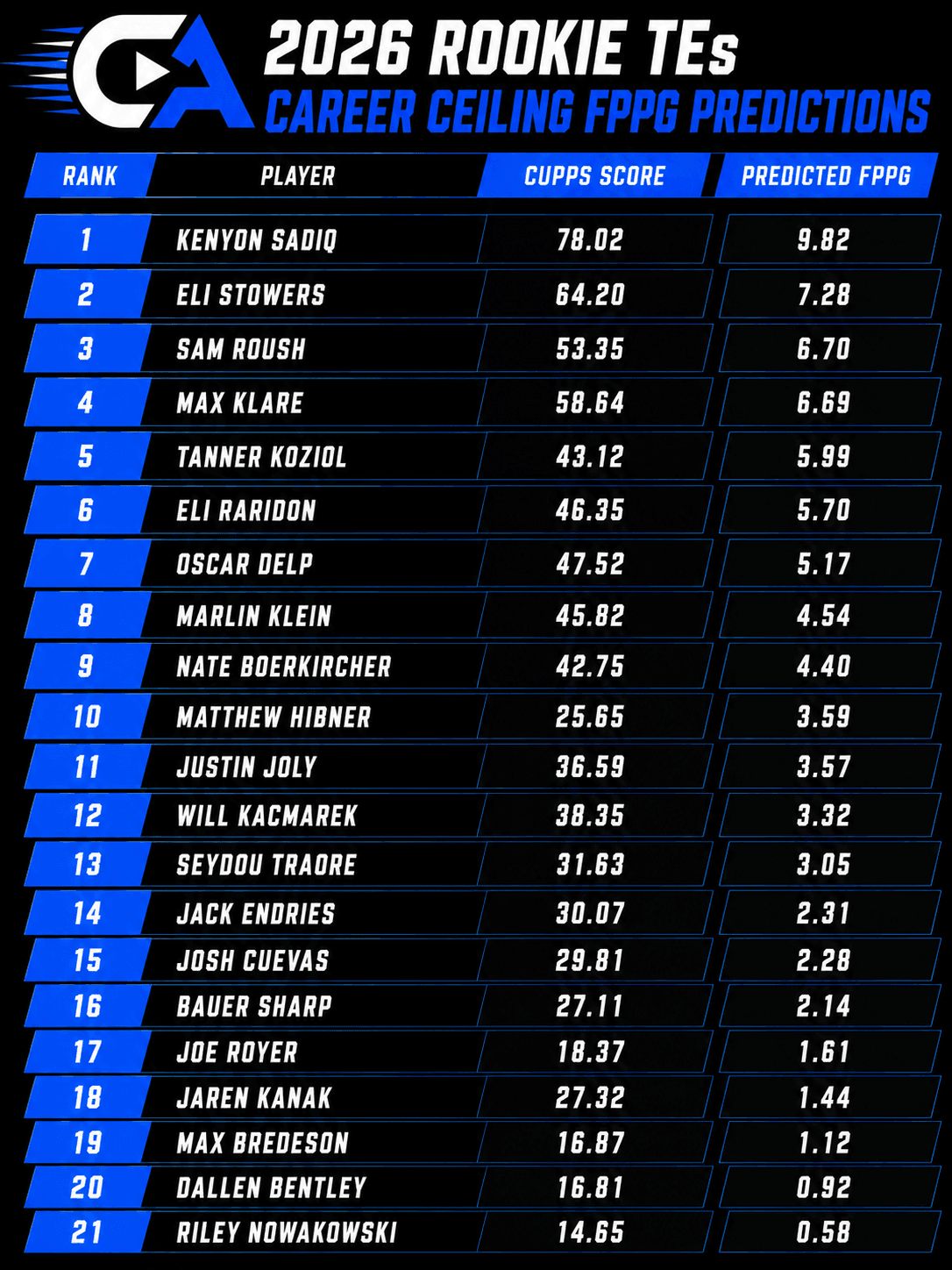
Key Takeaways:
- Kenyon Sadiq is a solid TE prospect, but he isn’t anywhere near the elite caliber we saw at the top of the 2025 class with Loveland and Warren—both of whom projected for 15+ FPPG. He comes out around the same projection as a tight end like Harold Fannin, who had worse draft capital but a much better production profile.
- Eli Stowers’ intriguing production profile and solid second-round draft capital keep him at a solid projection, although nothing near Earth-shattering.
- Tanner Koziol, the 164th overall pick by the Jacksonville Jaguars, absolutely skyrockets up the projection ranks due to his awesome production profile. He jumps eight of the tight ends drafted before him, including the Jags' second-round selection, Nate Boerkircher. Koziol is one of my favorite taxi squad stashes in dynasty right now, and I’d bet you can go get him off waivers for free right now.
- Tight end projections come out low across the board because it’s the position that proves hardest to predict fantasy ceiling specifically. The overwhelming majority of TEs rarely contribute in fantasy football (or never at all), which makes it all the more difficult to project for the absolute league-breakers like Kittle, Kelce, etc.
Players Mentioned in this Article
- JeremiyahLoveRBARI

- Proj
- 204.3
- CarnellTateWRTEN

- Proj
- 157.8
- JordynTysonQWRNO

- Proj
- 89.1
- KenyonSadiqTENYJ

- Proj
- 100.5
Published Updated